




Pakistan, Saudi Arabia, Türkiye, Egypt identify Israeli occupation as key source of regional instability
Web Desk
|
24 Oct 2026
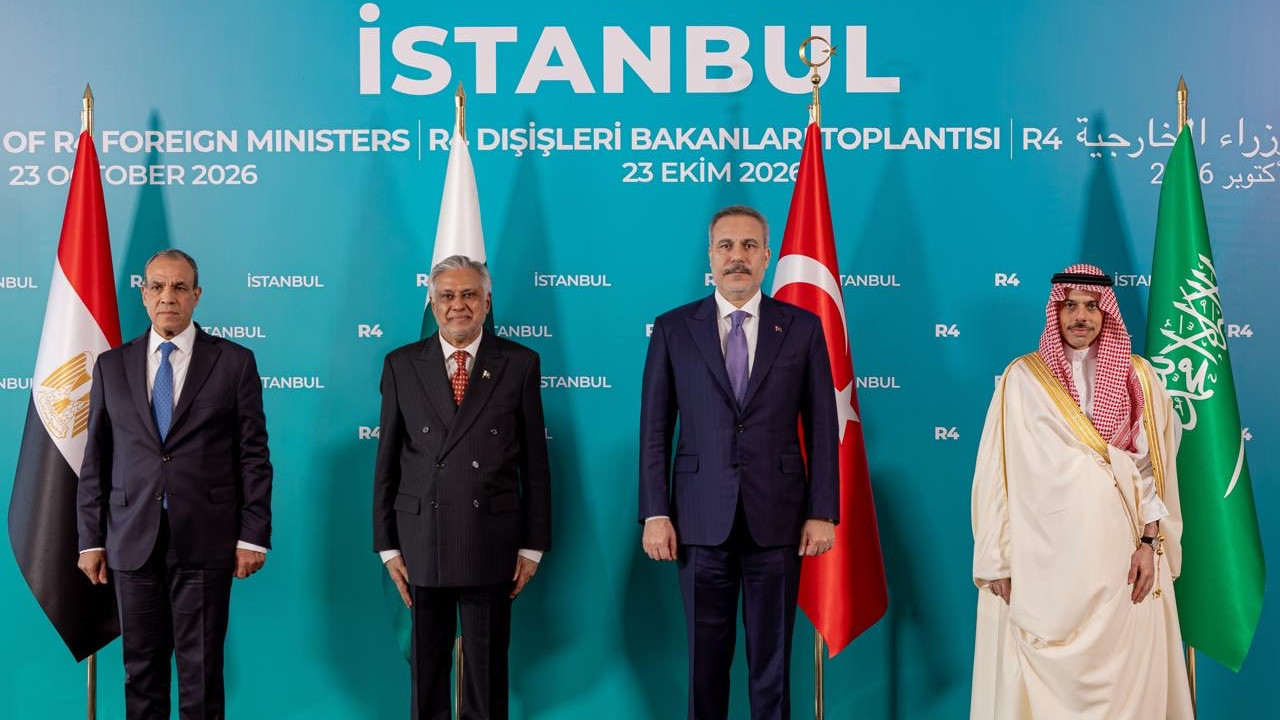
The foreign ministers of Saudi Arabia, Türkiye, Egypt and Pakistan, collectively known as the R4 Group, met in Istanbul to discuss key regional developments, reaffirming their commitment to diplomatic efforts aimed at promoting peace and stability in the region and beyond, in accordance with the principles and purposes of the United Nations Charter.
The ministers described the Israeli occupation as a fundamental source of regional instability, stating that Israeli policies have fuelled a deep sense of injustice among the global public.
They called for the early implementation of the two-state solution in line with relevant United Nations resolutions.
Reaffirming their support for the legitimate rights of the Palestinian people, the ministers stressed their inalienable right to self-determination and the establishment of an independent, sovereign, viable and contiguous State of Palestine based on the June 4, 1967 borders, with East Jerusalem as its capital.
They said the realisation of these rights was essential to achieving comprehensive peace in the Middle East.
The ministers also called for an immediate end to ongoing Israeli violence, efforts to alter the legal and historical status of Jerusalem, and the continued destruction and humanitarian suffering in Palestine.
They condemned Israeli settlement activities in the West Bank and Jerusalem, along with settler violence against Palestinians, and emphasised the urgent need for uninterrupted humanitarian assistance and reconstruction efforts in Gaza.
On Yemen, the ministers strongly condemned what they described as an unacceptable escalation by the Houthi militia, warning that its actions had further aggravated the humanitarian crisis.
They also denounced continued Houthi attacks against Saudi Arabia, particularly those targeting civilians and civilian infrastructure, as well as assaults on commercial shipping in the Red Sea and the Bab al-Mandeb Strait.
Expressing full solidarity with the internationally recognised Government of Yemen and Saudi Arabia, the ministers urged the Houthis to immediately halt all military operations, threats and attacks and return to the political process in good faith.
Addressing the military conflict involving the United States, Israel and Iran, as well as tensions surrounding the Strait of Hormuz, the ministers stressed that the crisis must be addressed through dialogue and diplomacy.
They called for the protection of civilians and civilian infrastructure, including vessels, and expressed support for the Islamabad Memorandum of Understanding (MoU).
The ministers also welcomed ongoing diplomatic initiatives aimed at preventing further escalation and reaffirmed their commitment to achieving a lasting, negotiated settlement.
The ministers underscored the critical importance of freedom of navigation, sustained maritime safety and security, and the protection of internationally recognised navigational rights and freedoms.
They warned that disruptions to vital maritime routes threaten global security and economic prosperity by obstructing supply chains and the movement of energy, fertilisers and food. Such disruptions, they noted, disproportionately affect vulnerable populations across the region and beyond.
The ministers stressed that these challenges require coordinated international efforts to safeguard maritime routes, maintain the uninterrupted flow of essential goods and prevent further regional and global instability.







Comments
0 comment